
CFD Analysis of Data Centers: The Complete Guide to Airflow, Cooling & PUE Optimization
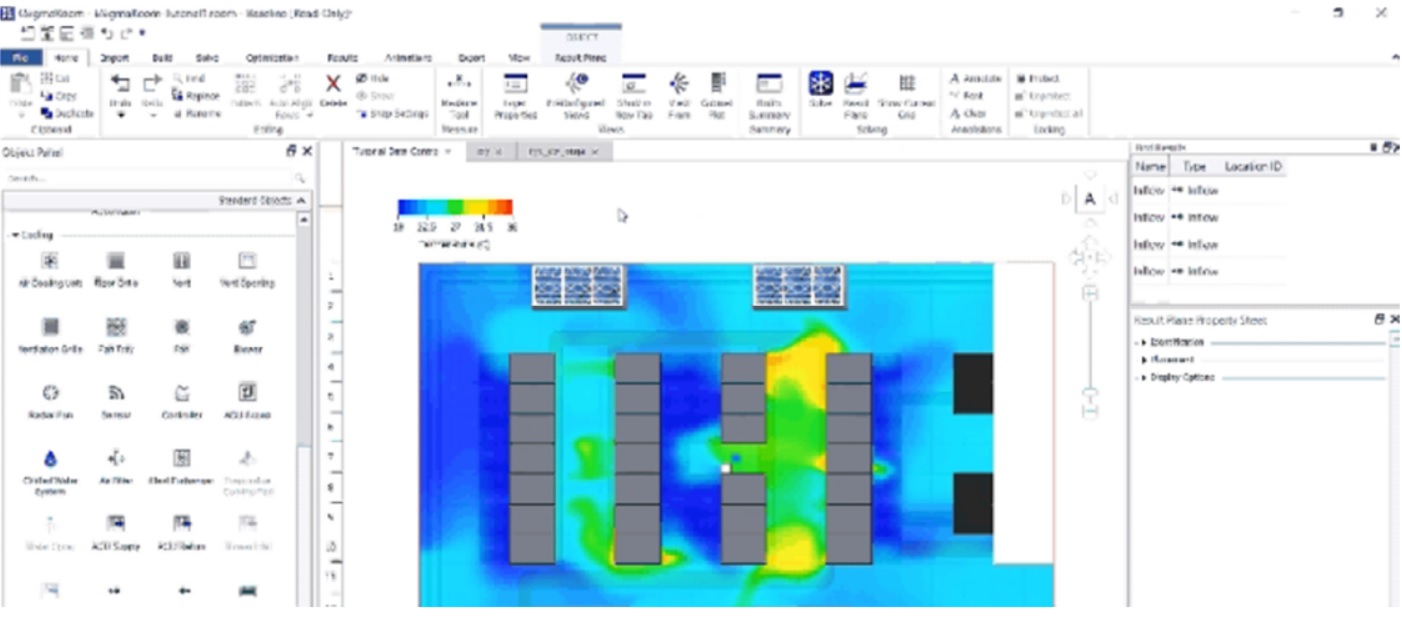
A single mis-angled perforated tile, an undersized CRAH unit, or one blanking panel left off a rack can quietly turn a well-built data center into a facility that runs hot, wastes power, and throttles under load. None of that shows up on a spec sheet. It shows up in a CFD analysis of the data center — and almost nowhere else, until it's already causing downtime.
CFD, short for Computational Fluid Dynamics, is the engineering discipline of simulating how air, heat, and pressure actually move through a real environment rather than assuming they'll behave the way the design intended. For data centers, that means building a digital twin of the facility — racks, containment, raised floor, CRAC/CRAH units and all — and running it through a physics solver before a single tile is placed or a single rack is powered up. This guide walks through what data center CFD analysis actually involves, when it earns its cost, and what to look for in a CFD analysis partner.
What Is CFD Analysis for Data Centers?
At its core, CFD analysis solves the equations that govern fluid motion — the Navier-Stokes equations — across a 3D mesh of the facility. Rather than treating the room as a single average temperature, the simulation divides the space into thousands or millions of small cells and calculates airflow velocity, pressure, and temperature in each one. The output isn't a single number; it's a complete map of exactly how cold air travels from the CRAH unit, through the plenum, up through each floor tile, into the rack intakes, and back out as exhaust.
For data centers specifically, this digital twin is built from the facility's real CAD or BIM geometry, real rack heat loads (in kW per cabinet), real CRAC/CRAH capacity, and real containment layout. The simulation then reveals what physical sensors alone cannot: where air is bypassing the racks entirely, where hot exhaust is recirculating back into a cold aisle, and which specific rack units are running hotter than the rest of the room average suggests.
Why Data Centers Need CFD Analysis
Temperature sensors tell you what's happening at a handful of fixed points. They don't tell you why, and they rarely catch a problem until it's already affecting equipment. A data center CFD analysis is predictive rather than reactive — it identifies airflow and thermal risks at the design stage, or before a retrofit, rather than after a server has already throttled or shut down.
Industry downtime surveys now put the median cost of a significant enterprise outage in this range — and cooling failures remain one of the most common root causes of unplanned data center downtime.
The risk isn't hypothetical. As rack densities climb with GPU and AI workloads, the thermal margin for error keeps shrinking — a facility designed around 5kW-per-rack assumptions can develop serious hot spots the moment a handful of cabinets are upgraded to 20kW or more. CFD analysis is what lets an operator answer "can this rack layout actually handle that density" with evidence instead of guesswork, before it becomes an incident.
The CFD Analysis Process, Step by Step
A rigorous data center CFD engagement generally follows five stages:
- Discovery brief. Understanding the facility, the design intent, and the specific thermal or capacity question being asked.
- Geometry & model build. Importing or building accurate 3D geometry from CAD/BIM data, with correct boundary conditions for every rack, cooling unit, and containment element.
- Simulation. Running the solver — steady-state for normal operation, transient for failure and ride-through scenarios.
- Analysis & insight. Reading the thermal maps and airflow vectors against the facility's actual goals: hot spot elimination, capacity headroom, PUE reduction, or compliance.
- Report & recommendations. A documented engineering report with visualizations and concrete, prioritized design changes — not just a picture of a problem.
Key Applications of CFD in Data Center Design
Hot Aisle / Cold Aisle Containment Design
CFD analysis validates containment layouts before installation, confirming that cold air actually reaches every rack intake and that hot exhaust air is fully separated rather than mixing back into the supply air.
CRAC/CRAH Placement & Optimization
Simulation shows whether cooling units are correctly sized and positioned, or whether some units are fighting each other's airflow — a common and expensive inefficiency that's invisible without a full-room model.
Rack-Level Thermal Validation
Individual cabinet heat loads, blanking panels, and cable congestion are modeled at rack level, so problem cabinets can be identified by row and position rather than by room-wide averages.
Raised-Floor & Underfloor Plenum Design
The underfloor plenum is where most bypass airflow originates. CFD analysis maps pressure and velocity beneath the floor to correctly size and place perforated tiles.
Redundancy & Failure-Scenario Modeling (N+1 / N+2)
Transient simulations show what actually happens to rack temperatures in the seconds and minutes after a CRAH unit fails — confirming whether the facility's redundancy design provides real ride-through time or only theoretical capacity.
Liquid Cooling & Hybrid Cooling Integration
As direct-to-chip and immersion cooling are introduced alongside traditional air cooling, CFD analysis models how the two systems interact in the same room, rather than assuming they operate independently.
Expansion & Capacity Planning
Before adding racks or increasing density, CFD analysis quantifies exactly how much thermal headroom the existing cooling infrastructure actually has left.
Business Impact: PUE, Uptime & ROI
Most of the financial case for CFD analysis comes from a simple pattern: facilities without airflow visibility tend to over-cool, because operators lower the setpoint to compensate for hot spots they can't precisely locate. Once CFD analysis identifies and corrects the actual cause — bypass airflow, recirculation, a poorly placed CRAH — that blanket over-cooling is no longer necessary.
| Outcome | Typical Impact |
|---|---|
| Cooling energy / PUE | 10–30% reduction after correcting identified airflow inefficiencies |
| Avoided physical prototyping | Design changes validated in simulation before costly floor changes |
| Hot-spot-driven failures | Identified and corrected before equipment is affected |
| Compliance | Reports structured to ASHRAE TC 9.9 thermal guidelines |
CFD Software Used for Data Center Analysis
Two platforms dominate serious data center CFD work. DCX by Cadence (formerly Future Facilities) is purpose-built for facility-scale data center modeling, with rack-level fidelity and fast what-if scenario testing built specifically around cabinets, CRAC/CRAH units, and containment. ANSYS Fluent is the industry-standard general-purpose CFD solver, used for complex thermal-fluid cases and multi-physics coupling. Large or multi-zone facility models are often run on cloud HPC platforms such as Rescale to shorten turnaround time. Commercially licensed versions of these tools matter: student or freeware CFD packages typically lack the solver accuracy, vendor support, and validation needed for results that hold up in an engineering report or regulatory submission.
Case Study: CFD Analysis of a US Data Center
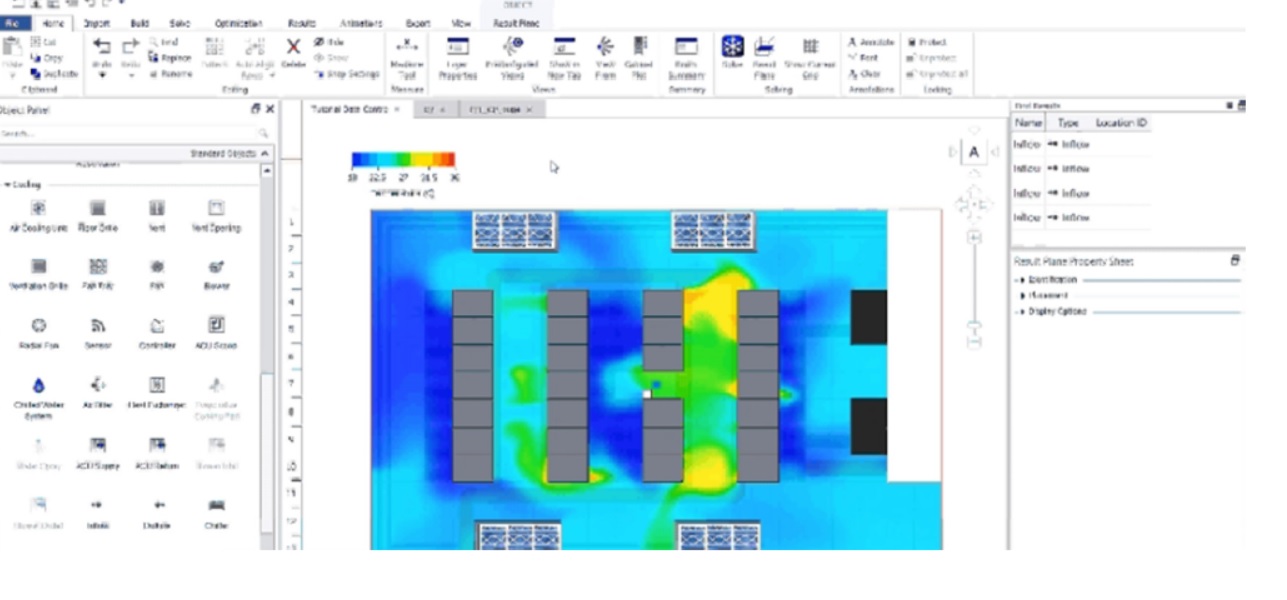
SuperDesignTech conducted a full data center CFD analysis for a US facility to ASHRAE TC 9.9 standards using ANSYS Fluent. The study examined velocity distribution across rack aisles, temperature profile for hot-spot identification, fresh-air supply rate, and air recirculation zones — mapping the room's temperature distribution across a 19°C to 29.7°C range. Recirculation zones were identified and the cooling layout was optimized for improved airflow efficiency and PUE reduction, with deliverables including a full HVAC performance report, velocity plots at multiple sections, and animated temperature visualizations at critical points.
Choosing a CFD Analysis Partner
Not all CFD analysis is equal. Before commissioning a study, it's worth confirming:
- Commercially licensed software — not student or free-tier solvers, which typically lack validated accuracy and vendor support.
- Data-center-specific tooling — dual expertise in both a general solver (ANSYS Fluent) and a facility-specific platform (DCX by Cadence) covers more scenarios than either alone.
- Standards alignment — reports structured to ASHRAE TC 9.9 and, where relevant, regional codes.
- Clear, actionable deliverables — a report that ends in prioritized design recommendations, not just colorful thermal maps.

About the Author
Rohit Sharma is Principal CFD Engineer at SuperDesignTech, with 20+ years of specialized experience in data center and thermal comfort CFD analysis using licensed ANSYS Fluent and DCX by Cadence. He completed exclusive DCX training with Future Facilities Ltd. (now Cadence) in London, and has delivered CFD studies for clients across the USA, Canada, and Europe, structured to ASHRAE TC 9.9, ASHRAE 55, and ISO 7730 standards.
Frequently Asked Questions
Q.What is CFD analysis for a data center?
It's a simulation technique that builds a 3D digital model of a facility and numerically solves how air, heat, and pressure move through it — revealing hot spots and airflow problems before they affect equipment.
Q.How much can CFD analysis reduce cooling costs?
Facilities that correct airflow issues identified through CFD analysis typically see cooling energy reductions of 10–30%, largely by removing the over-cooling used to compensate for problems that were previously invisible.
Q.What software is used for data center CFD analysis?
ANSYS Fluent and DCX by Cadence are the two industry-standard platforms, often paired with cloud HPC (such as Rescale) for large or complex facility models.
Q.How long does a data center CFD analysis take?
A typical full-facility study takes about 10–20 business days from kickoff to final report, depending on facility size and how many scenarios are being compared.
Q.Do smaller or edge data centers need CFD analysis?
Yes — smaller and edge facilities often run at higher rack densities relative to their cooling margin, so a single hot spot has less redundancy to absorb it before it becomes a real problem.
Have a Facility That Needs a Second Look?
SuperDesignTech runs data center CFD analysis using licensed ANSYS Fluent and DCX by Cadence — no upfront payment, fully remote, USA / Canada / Europe.
Or email rohit@superdesigntech.com directly.
0 Comments
Be the first to share your thoughts on this article.
Leave a Comment