
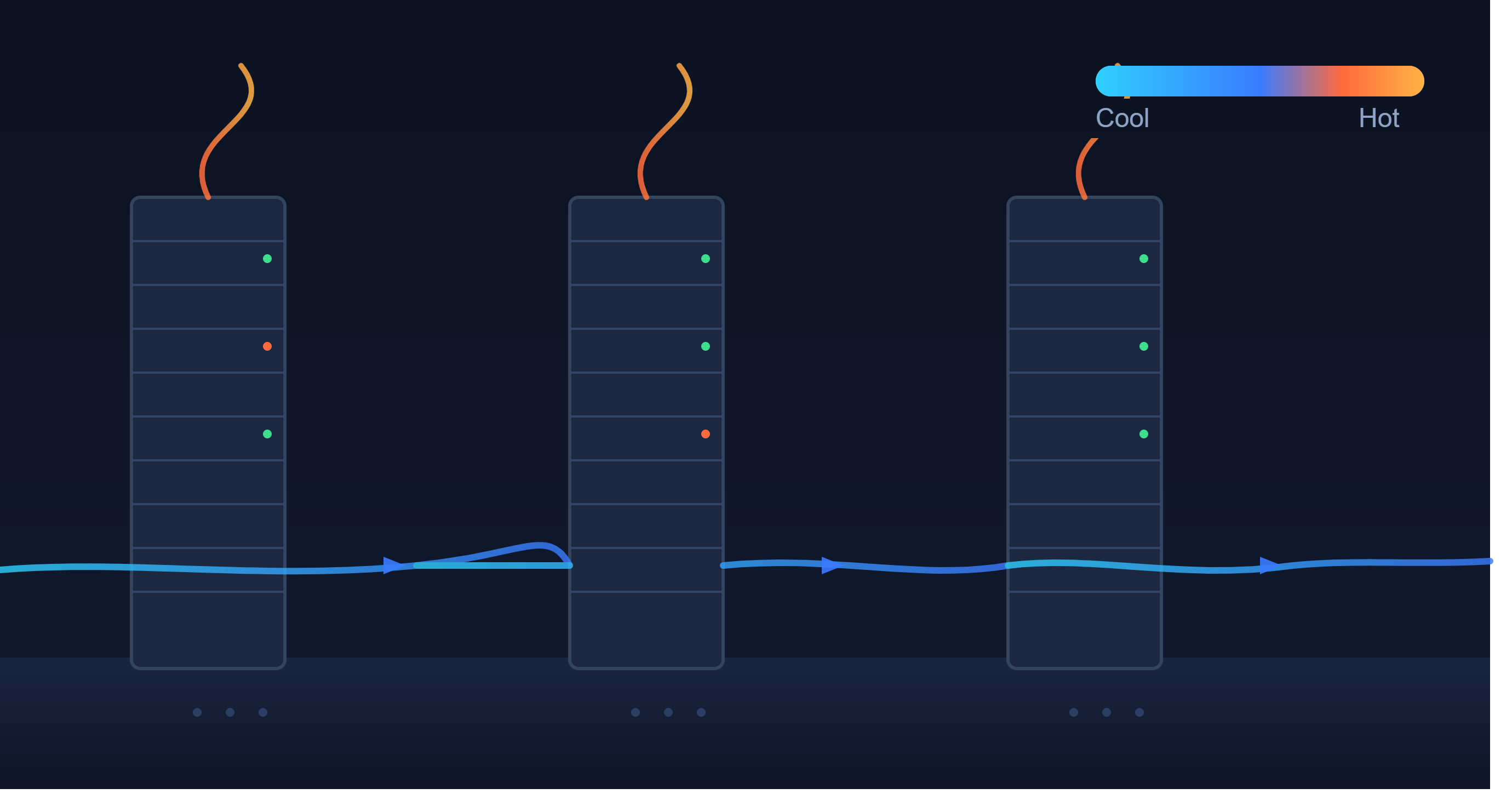
CFD Analysis of Data Center: The Complete Guide to Thermal Optimization & Energy Efficiency
Data centers are the invisible engines of the digital economy, and keeping them cool is one of the biggest engineering challenges facility managers face today. This is where CFD analysis of data center environments becomes essential. By using Computational Fluid Dynamics (CFD), engineers can simulate airflow, temperature distribution, and heat transfer inside a data center before a single server rack is installed — saving millions in energy costs and preventing costly downtime.
In this guide, we'll explore what CFD data center simulation is, why it matters, how it works, and how companies like SuperDesignTech use it to help clients design smarter, more efficient facilities.
What Is CFD Analysis of Data Center Facilities?
CFD analysis of data center infrastructure is the use of computational fluid dynamics software to model and visualize airflow patterns, temperature gradients, and heat dissipation within a server room or data hall. Instead of relying on guesswork or physical trial-and-error, engineers use CFD data center models to predict exactly how air moves through racks, aisles, cooling units, and raised floors.
A typical CFD data center simulation accounts for:
- Server rack heat loads (measured in kW)
- CRAC/CRAH (Computer Room Air Conditioning/Handling) unit placement and airflow rates
- Raised floor plenum design and perforated tile placement
- Hot aisle/cold aisle containment strategies
- Rack density and layout configuration
- Ceiling height and return air pathways
By modeling these variables together, a CFD data center study reveals hotspots, recirculation zones, and bypass airflow that would otherwise go undetected until equipment starts failing.
Why CFD Data Center Simulation Matters
1. Preventing Equipment Failure from Hotspots
Even a well-designed data center can develop localized hotspots where hot exhaust air mixes with cold supply air. Left unaddressed, this leads to server throttling, hardware degradation, and unplanned outages. CFD analysis of data center airflow identifies these risk zones early, allowing engineers to adjust tile placement, containment, or cooling capacity before problems occur.
2. Reducing Energy Costs (PUE Optimization)
Cooling accounts for a significant share of total data center energy consumption. A precise CFD data center model helps facility teams optimize Power Usage Effectiveness (PUE) by right-sizing cooling infrastructure instead of over-provisioning "just in case." This translates directly into lower operating expenses and a smaller carbon footprint.
3. Supporting High-Density Computing and AI Workloads
As AI and high-performance computing workloads push rack densities well beyond traditional limits, CFD analysis of data center layouts is critical for validating whether existing cooling infrastructure can handle 30kW, 50kW, or even 100kW+ racks — or whether liquid cooling integration is required.
4. De-Risking Capital Investment
Retrofitting a data center after construction is expensive. Running CFD data center simulations during the design phase lets stakeholders test multiple layout scenarios virtually, comparing containment strategies, cooling unit counts, and floor plans before committing capital.
How CFD Analysis of Data Center Projects Works: The Process
A typical CFD data center engagement follows these steps:
Step 1: Data Collection
Engineers gather architectural drawings, rack layouts, heat load data, cooling unit specifications, and airflow requirements.
Step 2: 3D Model Creation
A digital twin of the facility is built, including racks, floor tiles, cooling units, containment structures, and structural elements that affect airflow.
Step 3: Meshing and Boundary Conditions
The model is divided into a computational mesh, and boundary conditions — such as fan speeds, heat loads, and supply temperatures — are defined based on real equipment specifications.
Step 4: Simulation and Solving
The CFD software solves the governing equations of fluid flow and heat transfer, generating detailed maps of temperature, airflow velocity, and pressure throughout the space.
Step 5: Analysis and Visualization
Results are visualized as color-coded temperature maps, airflow vector plots, and pressure contours, making it easy to spot inefficiencies at a glance.
Step 6: Optimization Recommendations
Based on the CFD data center results, engineers recommend changes — repositioning tiles, adjusting containment, redistributing rack loads, or resizing cooling capacity.
Key Benefits of CFD Data Center Analysis at a Glance
- Improved reliability — fewer thermal-related outages
- Lower operating costs — optimized cooling reduces energy waste
- Better scalability — validate capacity before deploying new racks
- Sustainability gains — improved PUE supports ESG and green data center goals
- Faster commissioning — issues are caught in simulation, not in production
- Future-proofing — model scenarios for AI/HPC density growth
Common Use Cases for CFD Analysis of Data Center Design
- New Data Center Design — validating cooling architecture before construction
- Retrofit and Expansion Projects — testing whether existing infrastructure supports added rack density
- Containment Strategy Evaluation — comparing hot aisle vs. cold aisle containment performance
- Liquid Cooling Integration Planning — modeling hybrid air/liquid cooling transitions for AI workloads
- Redundancy and Failure Scenario Testing — simulating what happens if a CRAC unit goes offline
Why Choose SuperDesignTech for CFD Data Center Analysis
At SuperDesignTech, our engineering team specializes in CFD analysis of data center environments of all sizes — from single-room server closets to hyperscale facilities. We combine industry-leading CFD software with real-world data center design experience to deliver actionable, reliable results.
Our CFD data center services include:
- Comprehensive thermal and airflow simulation
- Hotspot identification and mitigation strategies
- PUE and energy efficiency optimization
- Rack density and capacity planning
- Cooling infrastructure sizing and layout design
- Ongoing digital twin support for facility monitoring
Whether you're designing a new facility or optimizing an existing one, our CFD data center analysis gives you the data-driven confidence to make smart infrastructure decisions.
Final Thoughts
As computing demands grow more intense — driven by cloud services, AI training, and edge computing — the margin for thermal error in data centers keeps shrinking. CFD analysis of data center infrastructure is no longer a nice-to-have; it's a critical tool for reliability, efficiency, and long-term scalability.
If you're planning a new data center build, expanding an existing facility, or simply want to understand where your cooling system is underperforming, a professional CFD data center study can uncover insights that save you money and prevent downtime for years to come.
Ready to optimize your facility?
Schedule a CFD Data Center Analysis
0 Comments
Be the first to share your thoughts on this article.
Leave a Comment