
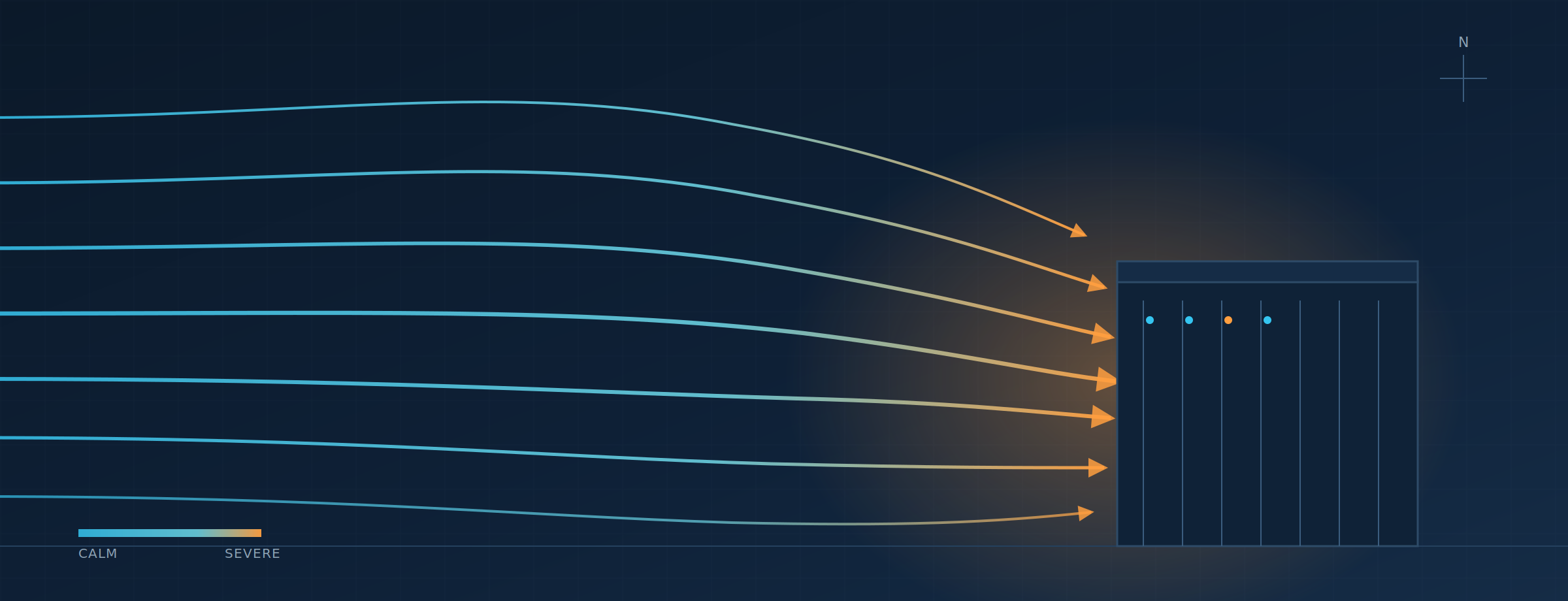
100 years of wind data. Zero surprises in the next storm.
How a cost-effective external CFD wind study helped an Australian data center stop reacting to storms — and start engineering around them.
A small data center operator in Australia had done its homework. A basic wind assessment during the site's planning phase looked routine — until a run of severe storms hit far harder, and far more often, than that early study had prepared them for.
Operations teams don't get the luxury of guessing when it comes to wind loading, pressure differentials around intake and exhaust systems, or debris risk near critical infrastructure. The company needed a clearer picture of exactly what their site was exposed to, and they needed a partner who could deliver that picture without a six-figure engineering retainer.
01 / The ChallengeStorms the original study never saw coming
The client's early-stage wind study had been built on limited assumptions — a reasonable approach for initial site planning, but not enough to hold up against real, recurring severe weather. By the time storms became a consistent operational disruption, it was clear they needed a proper external CFD (Computational Fluid Dynamics) wind study: one grounded in long-term climate history, not a single snapshot in time.
They came to SuperDesignTech looking for exactly that — a vendor who could be rigorous enough to trust, and cost-effective enough to justify.
02 / The ApproachBuilding a worst-case scenario from a century of data
Rather than modeling the site against a generic or regional wind standard, our team pulled and analyzed 100 years of historical wind data for the facility's exact location. That dataset was compiled and stress-tested to construct a genuine worst-case scenario — the conditions the site was statistically likely to face at its most extreme, not just its average day.
That worst-case model became the foundation for the full external CFD simulation: how wind actually moves across the terrain, accelerates around the building envelope, and interacts with the systems that keep the data center running.
03 / The ProcessFrom raw climate data to a decision-ready report
-
Historical wind data collection
A century of site-specific wind records was sourced and cleaned to establish real long-term exposure patterns.
-
Worst-case scenario modeling
The data was compiled into defined extreme-condition scenarios to serve as accurate simulation inputs.
-
External CFD simulation
Airflow, pressure loading, and turbulence around the facility were modeled under those worst-case conditions.
-
Detailed analysis report
Findings were translated into clear, actionable engineering insights — delivered within three weeks.
04 / The OutcomeFrom reactive to prepared
The completed CFD analysis gave the client a detailed, evidence-backed view of exactly how their site behaves under severe wind conditions — insight that let them get ahead of storm risk instead of scrambling to respond to it, whether the next event was minor or major.
"A year on, they're still thanking us for the work." SuperDesignTech, on the client relationship a year after delivery
05 / Why It MattersProven results, without the enterprise price tag
Data center operators don't always have an enterprise engineering budget — but they can't afford to under-study wind risk either. This project is a good example of what a focused, well-scoped external CFD wind study can deliver: rigorous, site-specific analysis, a fast three-week turnaround, and insights the client is still relying on more than a year later.
0 Comments
Be the first to share your thoughts on this article.
Leave a Comment